Reducing Energy Use in AI Training with SRT Compute
EuroCC Denmark – Case of the Month #9. This month, we highlight SRT Compute ApS, a Danish startup developing a novel optimisation approach to AI training.
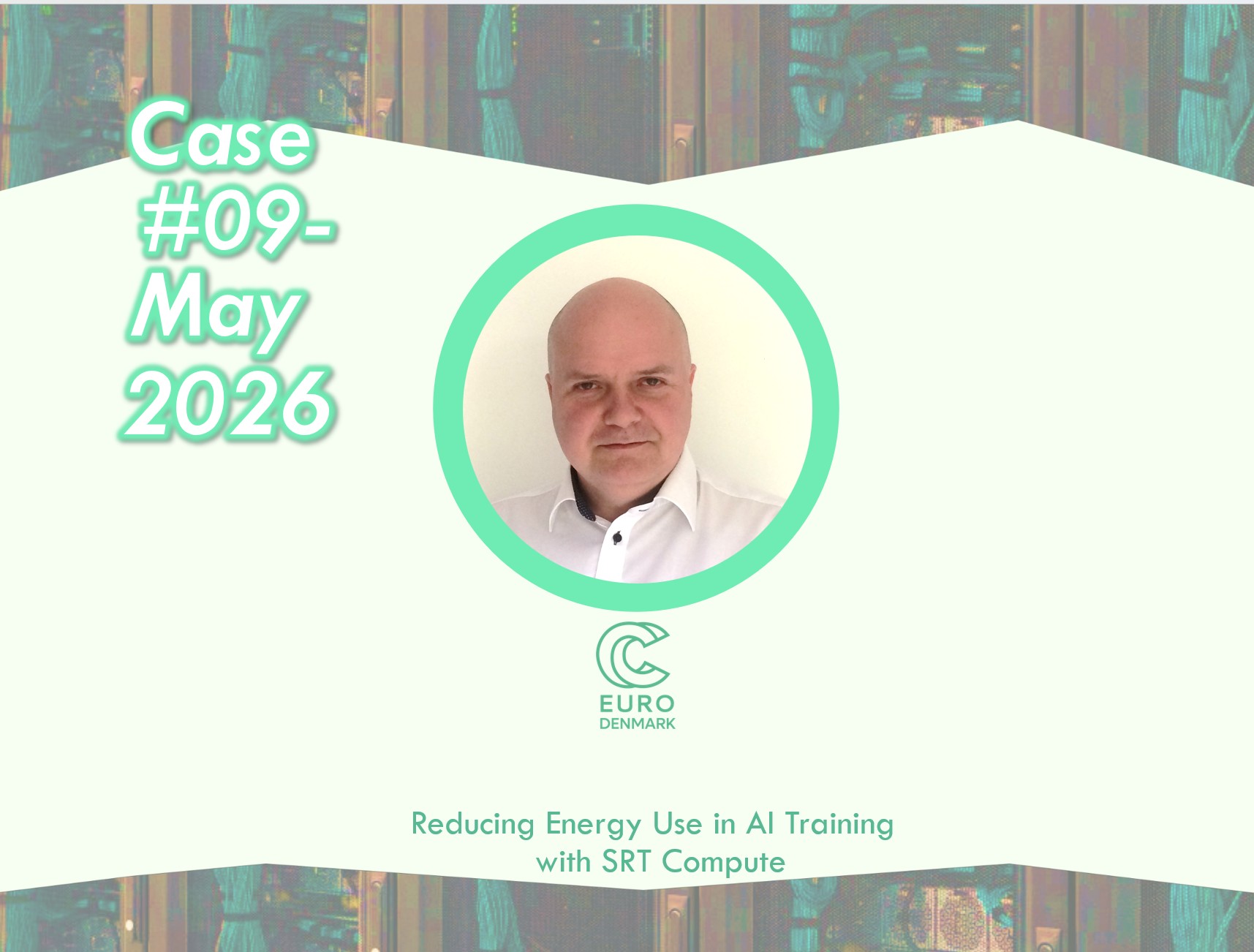
This month, we highlight SRT Compute ApS, a Danish startup developing a novel optimisation approach to AI training. Led by risk researcher Jesper Lyng Jensen, the company is tackling one of the most pressing challenges in AI today: the rapidly growing energy consumption of large-scale model training.
Through EuroCC Denmark, SRT Compute gained access to LUMI, one of the world’s most powerful supercomputers, via the LUMI AI Factory, along with technical guidance to bring their innovation from concept to large-scale testing.
The Challenge
AI training is notoriously energy-intensive, with consumption increasing exponentially as models grow in size and complexity. Typically, improving model accuracy requires even more computational power, creating a trade-off between performance and sustainability.
SRT Compute set out to challenge this assumption with their algorithm, Risk Adjusted Budget Optimiser (RABO), designed to simultaneously improve training precision while significantly reducing energy consumption. However, demonstrating this effect at scale required access to substantial GPU resources, far beyond what is typically available to startups without major funding.
The Solution
EuroCC Denmark supported SRT Compute throughout the entire process, from initial dialogue to application and onboarding, helping them secure 5,000 GPU hours on the LUMI supercomputer as an initial allocation. SRT Compute has since submitted an application for a further 5,000 compute hours.
In addition to enabling access, EuroCC Denmark provided guidance on how to effectively utilise HPC resources, ensuring the company could run and validate their training experiments in a high-performance environment. This support allowed SRT Compute to move quickly from theory to real-world testing without the financial barriers usually associated with large-scale compute.
Impact
Early results indicate that the RABO algorithm can reduce energy consumption in AI training by approximately 40-50% while maintaining, or even improving, model accuracy. If validated at scale, this represents a significant breakthrough, as these two factors typically move in opposite directions.
Access to LUMI enables SRT Compute to rigorously test and refine their approach, accelerating their path toward commercialisation. More broadly, their work highlights the potential for making AI development significantly more sustainable, with meaningful global impact as demand for AI continues to grow.
Risky Business’ journey demonstrates how EuroCC Denmark helps startups overcome critical barriers by combining access to world-class supercomputing infrastructure with hands-on technical support. From idea to proof of concept, we empower innovators to develop scalable, high-impact and energy-efficient AI solutions.
Stay tuned for more stories like this.